
KiwiSaver Employer Contributions – Are You Getting It Right?

KiwiSaver is an important part of employee remuneration in New Zealand, but getting employer contributions right involves more than simply setting up a deduction in your payroll system. Employers need to understand contribution rates, Employer Superannuation Contribution Tax (ESCT), employee eligibility, payroll reporting and the rules that apply when an employee's circumstances change.
With important KiwiSaver changes taking effect from 1 April 2026, now is a good time for businesses to review their payroll processes and ensure their systems are up to date. The default employee and matching employer contribution rate increased from 3% to 3.5%, with a further increase to 4% scheduled for 1 April 2028.
For employers, getting these details right helps maintain compliance, avoid payroll errors and ensure employees receive the contributions they are entitled to.
1. Understanding employer KiwiSaver contributions
In most cases, when an eligible employee contributes to KiwiSaver through their salary or wages, their employer must also make a compulsory contribution to the employee's KiwiSaver scheme or an eligible complying fund.
From 1 April 2026, the minimum compulsory employer contribution rate is generally 3.5% of the employee's gross salary or wages. This contribution is normally made on top of the employee's regular salary or wages, subject to specific exceptions and the terms of any valid remuneration arrangement.
For example, if an eligible employee earns $1,000 in gross pay for a pay period, the basic employer contribution at 3.5% would be $35 before ESCT.
However, the amount ultimately credited to the employee's KiwiSaver account may be lower because ESCT is generally deducted from the employer contribution.
It is important to distinguish between:
Employee contributions: Deducted from the employee's salary or wages at their chosen contribution rate.
Employer contributions: Paid by the employer to support the employee's retirement savings.
ESCT: Tax deducted from employer contributions before the net contribution is paid into the relevant scheme.
These are separate payroll items and should be calculated and recorded correctly.
2. The 2026 KiwiSaver rate changes employers need to know
The KiwiSaver changes introduced in 2026 mean employers should not assume their existing payroll settings are still correct.
From 1 April 2026
The default employee contribution rate and minimum matching employer rate increased from 3% to 3.5%. Eligible employees aged 16–17 also became eligible for compulsory employer contributions, subject to the relevant requirements.
From 1 April 2028
The default employee contribution rate and minimum matching employer rate are scheduled to increase again, from 3.5% to 4%. Employers should plan ahead for this change.
IEmployees can apply for a temporary reduction to 3% for a period of three to 12 months. Employers must apply a valid reduction notice when received. They may also choose to reduce their employer contribution to 3% while the employee's temporary reduction is active. When the temporary reduction ends, payroll settings need to be updated again.
What employers should do now: review payroll software, employee contribution records and temporary rate reduction notices to ensure the correct rate is being applied to each payday.
3. Understanding Employer Superannuation Contribution Tax (ESCT)
One of the most common areas of confusion is ESCT.
ESCT is the tax generally deducted from employer contributions to KiwiSaver and eligible complying funds. It is separate from PAYE and is calculated using the employee's relevant income and employment history.
The applicable ESCT rate is not necessarily the same for every employee. Inland Revenue's rates range from 10.5% to 39%, depending on the employee's relevant income threshold. Employers should calculate and review the appropriate rate for each employee, generally at the beginning of each tax year and when circumstances require it.
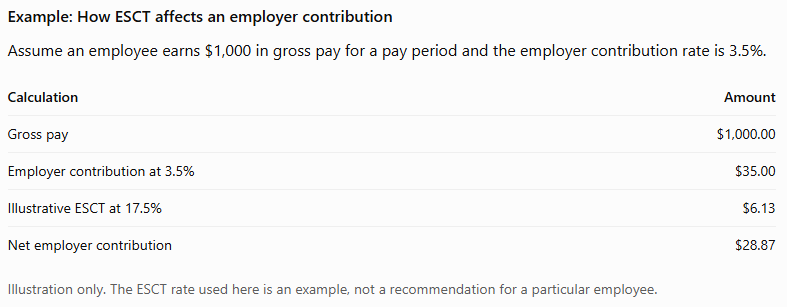
The employer contribution is $35 before tax, but approximately $28.87 reaches the employee's KiwiSaver account after the illustrative ESCT deduction.
A common mistake is to calculate the employer contribution correctly but apply the wrong ESCT rate. This can result in incorrect tax deductions and reporting.
Employers should ensure their payroll system calculates ESCT correctly, records the tax deducted and reports the net employer contribution accurately.
4. Who is eligible for compulsory employer contributions?
Eligibility needs to be checked for each employee rather than assuming every person on the payroll is treated the same way.
Generally, compulsory employer contributions apply where an employee:
Is aged 16 or over and under the applicable age of eligibility.
Is a KiwiSaver member or member of an eligible complying fund.
Has KiwiSaver deductions being made from their salary or wages.
Is not covered by an applicable exception, such as a sufficient contribution arrangement under another eligible superannuation scheme.
Specific rules can apply to employees who are on savings suspension, are eligible to withdraw their savings, receive certain types of payments, or have reached the relevant age for NZ Superannuation.
From 1 April 2026, eligible 16- and 17-year-old KiwiSaver members became entitled to compulsory employer contributions. Employers should therefore review their payroll records to ensure eligible younger employees are not inadvertently excluded.
If you are unsure whether an employee qualifies, check the relevant Inland Revenue guidance before changing their contributions.
5. Are employer contributions included in salary packages?
Employers also need to understand how KiwiSaver contributions interact with employment agreements and remuneration packages.
As a general rule, compulsory employer contributions must be made on top of an employee's regular salary or wages. An employer should not simply deduct the compulsory contribution from an employee's agreed salary in a way that leaves them receiving less than their contractual pay.
Some employment agreements use a total-remuneration arrangement that includes an employer contribution component. These arrangements need to be structured correctly, comply with employment and minimum-wage requirements, and be understood by both parties.
For example, an employee receiving an agreed salary should not have their salary reduced merely because the employer now has a higher compulsory contribution cost.
Before changing salary structures or employment agreements, seek appropriate payroll, accounting and employment advice.
6. How bonuses, overtime and other payments affect contributions
KiwiSaver calculations depend on the relevant gross salary or wages, and the definition used for KiwiSaver is not necessarily identical to every other payroll calculation.
Payments such as bonuses, commission, overtime and extra salary can be included in the relevant gross pay calculation. Certain payments, such as redundancy payments, are treated differently.
This is particularly important for businesses with variable pay arrangements, including:
Sales teams receiving commission.
Employees who regularly work overtime.
Staff receiving performance bonuses.
Employees receiving back pay.
Workers whose earnings fluctuate from one pay period to another.
A payroll system needs to apply the appropriate KiwiSaver calculation rules to the relevant payment types. Assuming that every payment is treated the same way can lead to underpayments or incorrect deductions.
7. What happens when an employee changes their contribution rate?
Employees can generally choose a contribution rate of 3.5%, 4%, 6%, 8% or 10%, or obtain an approved temporary reduction to 3%.
They may notify their employer in writing, submit a KiwiSaver deduction form (KS2), or make a change through their provider or Inland Revenue. Employers must apply the updated rate when the appropriate notification is received and retain the supporting records.
An employee's contribution rate may change because of a new request, a temporary reduction or the expiry of an approved reduction period.
Employers should not rely solely on the rate originally entered when an employee joined the business. Payroll records need to be maintained as changes occur.
A good process includes:
Recording the date each rate change takes effect.
Keeping copies of written requests and temporary reduction notices.
Updating payroll before the relevant pay is processed.
Reviewing temporary reductions approaching their expiry dates.
Confirming that the correct employer contribution is being calculated.
Remember that an employee's temporary reduction to 3% does not automatically require the employer to reduce its contribution. The employer can choose to match the reduced rate while the approval is active, subject to the applicable rules.
8. What about employees on leave or receiving special payments?
Employees on accident compensation, paid parental leave or other forms of leave may have different circumstances affecting KiwiSaver deductions and employer contributions.
The correct treatment depends on the type of payment, who pays it and whether KiwiSaver deductions are being made. Back pay can also trigger employer contribution obligations when KiwiSaver deductions are taken from the relevant payment.
Rather than applying a blanket rule to every leave situation, employers should check the specific circumstances and confirm how the payment should be treated.
This is particularly important when an employee receives payments from more than one source or returns to work after an extended period of leave.
9. Payday filing, payments and record keeping
Correct calculations are only one part of KiwiSaver compliance. Employers must also ensure contributions and associated tax are reported and paid correctly.
For each payday, employers should:
Calculate employee deductions using the applicable contribution rate.
Calculate the employer contribution using the correct rate and gross pay.
Deduct the appropriate ESCT.
Report the relevant deductions, tax and net employer contributions through the required employer reporting process.
Pay the amounts by the applicable due date.
For KiwiSaver schemes, employer contributions and employee deductions are generally paid to Inland Revenue with the employer's other payroll deductions. Payments for complying funds follow different arrangements and may need to be paid directly to the fund.
Employers should also retain records of employee contribution rates, payroll calculations, ESCT deductions, savings suspensions, temporary reduction notices and other relevant documentation. Inland Revenue advises employers to keep KiwiSaver records for seven years.
10. Common KiwiSaver employer mistakes to avoid
Even businesses with established payroll systems can make mistakes when rates or employee circumstances change.
Watch out for these common issues:
Using outdated rates: Failing to update payroll for the 3.5% rate that took effect on 1 April 2026.
Applying the wrong ESCT rate: Using one rate for every employee without checking their relevant income.
Missing eligible employees: Overlooking eligible 16- and 17-year-old employees.
Ignoring temporary rate reductions: Failing to process valid notices or restore the standard rate when the reduction expires.
Incorrect salary-package treatment: Assuming compulsory employer contributions can always be taken out of an employee's agreed salary.
Incorrect payment treatment: Applying the wrong KiwiSaver calculation to bonuses, overtime or back pay.
Poor record keeping: Not retaining contribution-rate changes and supporting documents.
Late or inaccurate reporting: Failing to reconcile payroll records with employer returns and payments.
Regular checks can help identify errors early and reduce the risk of corrections, employee concerns and compliance problems.
11. A practical KiwiSaver payroll checklist for employers
Use this checklist when reviewing your payroll processes.
KiwiSaver payroll review
Confirm payroll uses the correct contribution rate for each employee
Review employee eligibility, including eligible 16- and 17-year-olds
Check each employee's ESCT rate
Process valid contribution changes and temporary rate reduction notices
Review salary packages and employment agreements
Check treatment of bonuses, overtime, back pay and leave payments
Reconcile employer contributions, ESCT and payday filing
Confirm payment deadlines and payment arrangements
Retain KiwiSaver records and supporting notices for seven years
Plan ahead for the scheduled 4% rate change on 1 April 2028
How Tax Professionals can help
Managing payroll involves more than processing wages. KiwiSaver contribution rates, ESCT calculations, employee changes and reporting requirements all need to work together accurately.
At Tax Professionals, we help businesses manage payroll and accounting responsibilities with practical support tailored to their needs.
Our payroll support can help your business:
Review payroll settings and KiwiSaver contribution calculations.
Check ESCT treatment and employer contribution records.
Maintain accurate payroll reporting and documentation.
Manage employee rate changes and related payroll processes.
Stay informed about important tax and payroll changes.
Whether you employ a small team or manage a growing workforce, reviewing your payroll processes can help prevent avoidable errors and give you greater confidence that your obligations are being met.
Are your KiwiSaver employer contributions being handled correctly?
Contact Tax Professionals to discuss your payroll requirements.
Phone: 09 625 0035 Website: www.taxprofessionals.co.nz
This article provides general information for New Zealand employers as at October 2026. KiwiSaver rules and individual circumstances can differ. Check current Inland Revenue guidance or obtain professional advice before making payroll decisions.