
Smart Ways to Take Money Out of Your Company

For many business owners, one of the most common questions is:
"How do I pay myself from my company?"
While your company may be profitable, it's important to remember that a limited liability company is a separate legal entity. The money in the company's bank account does not automatically belong to you personally.
Choosing the right way to extract money from your company can have a significant impact on your tax bill, ACC levies, cashflow and compliance obligations.
There are four common ways business owners receive money from their company:
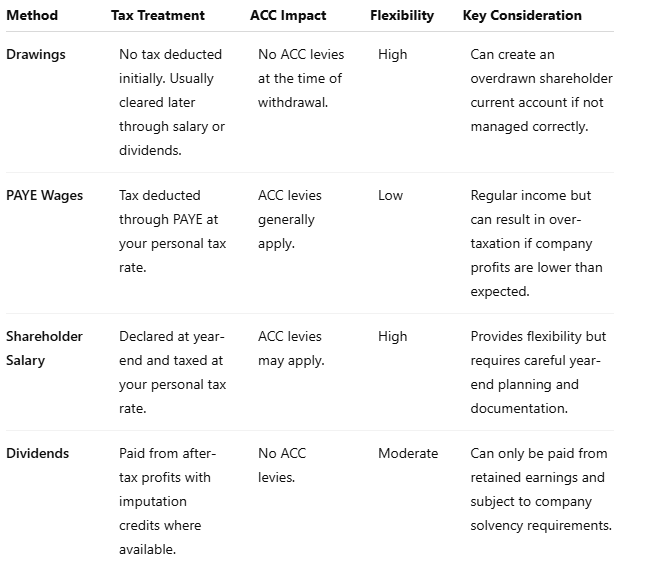
1. Drawings – Flexible but Needs Monitoring
Many owner-operators simply transfer money from the company bank account whenever they need it.
These withdrawals are known as drawings and are recorded in the shareholder's current account.
Drawings are convenient because they provide flexibility throughout the year. However, they are not income by themselves.
If you withdraw more money than the company owes you, your shareholder current account becomes overdrawn.
An overdrawn current account may be treated as a loan from the company to the shareholder. Depending on the circumstances, Inland Revenue may require interest to be charged at the prescribed rate, with tax implications for both the company and the shareholder.
The best practice is to review the current account before year-end and clear any overdrawn balance through a shareholder salary, dividend or repayment where appropriate.
2. PAYE Wages – Regular Income with Less Flexibility
Many directors choose to place themselves on the company's payroll just like any other employee.
Each pay period:
PAYE is deducted.
Employer obligations are met.
Income is reported to Inland Revenue.
You receive a regular, predictable income.
This approach can be particularly useful if you are:
Applying for a mortgage.
Seeking finance.
Wanting consistent personal cashflow.
However, setting your salary too high can create tax inefficiencies.
If the company earns less profit than expected—or even makes a loss—you may have paid more PAYE than was necessary. While the position can often be reconciled through the tax system, careful planning helps avoid unnecessary complications.
PAYE wages also generally attract ACC levies based on your liable earnings.
3. Shareholder Salary – A Flexible Year-End Strategy
A shareholder salary is one of the most common methods used by owner-managed companies in New Zealand.
Unlike PAYE wages, a shareholder salary is usually determined after the financial year has ended, once your accountant knows the company's actual taxable profit.
This allows your accountant to:
Review the company's financial performance.
Calculate the most tax-efficient level of remuneration.
Allocate income between the company and shareholder appropriately.
Because the amount is determined after the year's results are known, a shareholder salary offers significantly more flexibility than fixed weekly wages.
Where appropriate, it may also reduce the company's taxable income.
However, shareholder salaries must:
Be commercially reasonable.
Be properly authorised and documented.
Be correctly recorded in the company's financial statements and tax return.
Depending on your circumstances, shareholder salaries may also be subject to ACC liable earnings.
For many business owners, ACC CoverPlus Extra can provide greater certainty by allowing ACC cover to be agreed in advance rather than fluctuating based on earnings. Whether this option is suitable depends on your individual circumstances and should be discussed with your accountant or ACC adviser.
4. Dividends – Sharing Company Profits
Once your company has paid income tax, it may distribute some of its after-tax profits to shareholders as dividends.
One of the major advantages of dividends is the use of imputation credits.
When a company pays tax at the corporate tax rate, those tax payments are recorded in an imputation credit account. These credits can often be attached to dividends, meaning shareholders receive credit for tax the company has already paid.
This reduces the likelihood of the same income being taxed twice and often results in a lower amount of additional tax payable by the shareholder, depending on their personal tax rate.
However, dividends have important restrictions.
A company generally:
Must have sufficient retained earnings available.
Must satisfy the legal solvency test before paying a dividend.
Cannot pay dividends simply to create or increase a tax loss.
Proper documentation, including director resolutions, is also essential.
Which Method Is Best?
There is rarely a single "best" option.
Many business owners use a combination of methods throughout the year.
For example:
Drawings to cover day-to-day living expenses.
A shareholder salary determined at year-end to manage taxable income.
Dividends when the company has accumulated retained earnings and imputation credits.
The most suitable approach depends on factors such as:
Company profitability.
Your personal tax rate.
Cashflow requirements.
ACC obligations.
Future borrowing needs.
The company's retained earnings and tax position.
Questions to Ask Your Accountant
Before your financial statements are finalised each year, consider asking:
Is my shareholder current account in credit or debit?
Have we chosen the most tax-efficient mix of salary, wages and dividends?
Are there sufficient imputation credits available?
Is my ACC position appropriate?
Have all shareholder transactions been properly documented?
Final Thoughts
Taking money out of your company isn't simply a matter of transferring funds from the business bank account. Each method has different tax, ACC and compliance implications, and the right strategy can help you improve cashflow while avoiding unnecessary tax costs.
With careful planning and professional advice, you can ensure you're extracting profits in a way that is both tax-efficient and compliant with New Zealand tax law.
If you're unsure whether you're paying yourself the most effective way, speak with Tax Professionals. We can review your current structure, explain your options and help you develop a remuneration strategy that aligns with your business and personal financial goals.