
Repairs vs Improvements – What Can You Deduct?

When you own a rental property or operate a business in New Zealand, repairs and maintenance can be a significant expense. From fixing a leaking roof and replacing damaged flooring to renovating a kitchen or upgrading building systems, it is important to understand how these costs are treated for tax purposes.
The key question is whether the work repairs or maintains an existing asset, or whether it improves or creates a new asset. Repairs and maintenance may qualify for an immediate tax deduction, while capital improvements generally cannot be deducted in full as an expense in the year the money is spent.
Getting this distinction right can help you claim legitimate deductions, maintain accurate records and avoid unexpected tax adjustments if Inland Revenue (IRD) reviews your expenses.
In this guide, Tax Professionals explains the difference between repairs and improvements, how the rules apply to rental properties and businesses, common mistakes to avoid, and what records you should keep.
1. What is the difference between repairs and improvements?
New Zealand tax rules distinguish between revenue expenditure, which may be deductible immediately, and capital expenditure, which generally is not immediately deductible.
The distinction depends on the work carried out, the asset being worked on and the overall effect of the work. Inland Revenue issued updated guidance in March 2026 under Interpretation Statement IS 26/01, replacing its previous general guidance on repairs and maintenance.
Repairs and maintenance
May be immediately deductible
These costs generally restore or maintain an existing asset without substantially changing its character.
Examples include fixing a leaking tap, repairing a broken window, patching damaged plasterboard or repainting a property to maintain its existing condition.
Capital improvements
Generally not immediately deductible
These costs generally add something new, substantially improve an asset or change its character.
Examples include adding an extra room, installing double glazing where there was none, or substantially upgrading an existing building.
An expensive job is not automatically a capital improvement, and a relatively inexpensive job is not automatically deductible. The nature and extent of the work matter more than the invoice amount alone.
2. How does Inland Revenue assess the work?
A useful starting point is to work through two questions.
Step 1: Identify the asset being repaired.
Determine what the relevant asset is. It might be a complete building, part of a building, a vehicle, a machine or a separate piece of equipment.
For example, replacing one damaged component of a building may be a repair. Reconstructing or replacing substantially the whole relevant asset may instead be capital expenditure.
Step 2: Assess the nature and extent of the work.
Consider whether the work simply remedies wear and tear or damage, or whether it substantially renews, reconstructs, improves or changes the asset.
Relevant factors can include:
The condition of the asset before the work.
The proportion of the asset being repaired or replaced.
Whether the asset's character, function or capacity has changed.
Whether the work goes beyond restoring the asset.
The cost of the work relative to the asset's value and the extent of the project.
No single factor determines the answer. The assessment depends on the facts of the particular situation.
3. Examples of repairs versus improvements
The following examples illustrate how the distinction may apply. They are general guidance, not automatic classifications.
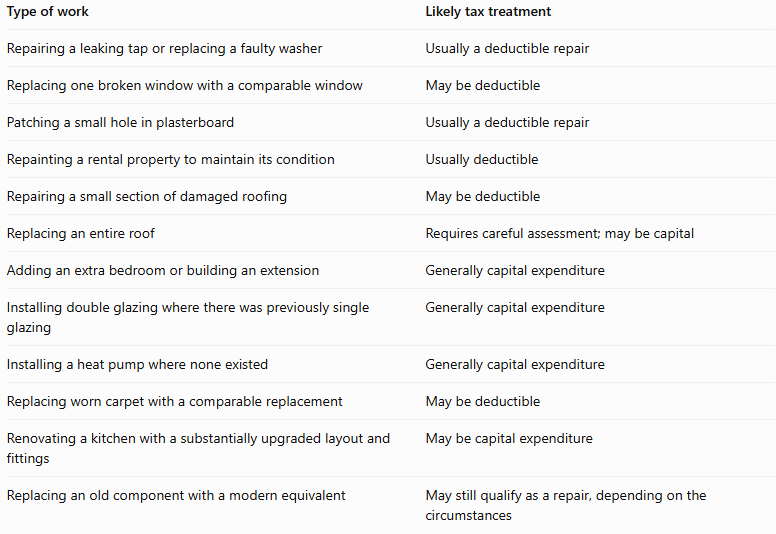
Inland Revenue specifically identifies replacing a broken window, repairing a hole in plasterboard and repainting as examples of rental property repairs. It identifies adding a room, installing previously absent heat pumps and installing double glazing as examples of capital improvements.
The important point is to assess the actual work, rather than relying only on descriptions such as “maintenance”, “replacement” or “renovation” on a contractor's invoice.
4. What if you replace an entire asset or a substantial part of it?
This is one of the more difficult areas.
Replacing a small component of an asset may be a repair, but replacing or reconstructing a substantial part of an asset can indicate capital expenditure. For buildings, the relevant question includes whether the work effectively renews a substantial part of the building or changes its character.
For example, repairing several damaged roof tiles may be different from replacing the entire roof structure as part of a major building project.
However, the scale of the job does not settle the matter by itself. A substantial repair can still qualify as deductible in some circumstances if it does not reconstruct the whole relevant asset or change its character.
Before approving a major replacement project, property owners and businesses should obtain tax advice on the proposed scope of work.
5. What happens when a project includes both repairs and improvements?
A single project may contain both deductible repairs and non-deductible capital improvements.
For example, a property owner might:
Repair a damaged section of an existing wall.
Replace worn fittings with comparable items.
Extend the room and install a new layout.
Upgrade other parts of the property.
The first two items may qualify as repairs, while the extension and some upgrades may be capital expenditure. The final treatment depends on how the work fits together and the nature of the asset being worked on.
Where the expenditure can reasonably be divided between distinct repair work and capital improvements, a reasonable allocation may be appropriate. However, it is not always possible to split a project simply by separating labour and materials on an invoice. The overall nature of the work must still be considered.
Practical tip: Ask your contractor to provide a detailed scope of work and itemised invoices. This makes it easier to identify what was repaired, what was replaced and what was added or upgraded.
6. What if you have just purchased a property?
Repairs carried out soon after purchasing a property need particular attention.
Suppose you buy a rental property and immediately spend money fixing defects that existed when you purchased it. The fact that the work is described as a repair does not automatically make it deductible.
If the work is necessary to put the recently acquired asset into a usable or income-earning condition, the expenditure may be capital in nature, depending on the circumstances. Inland Revenue addressed this issue in its July 2025 guidance, QB 25/17.
Consider two situations:
Situation A: You have owned and rented a property for several years. A pipe develops a leak, and you pay a plumber to repair it. This would generally be treated as a repair, subject to the usual deduction requirements.
Situation B: You purchase a property with significant existing defects and immediately carry out extensive work before it can be rented. Some or all of the expenditure may be capital.
The timing of the work is relevant, but it is not the only consideration. The nature of the defects, the property's condition when acquired and the extent of the work all matter.
7. Repairs and improvements for rental property owners
Rental property owners commonly incur costs for painting, plumbing, roofing, flooring, electrical work and general maintenance.
Where a residential rental property is used wholly to earn rental income, qualifying repair and maintenance expenses can generally be deducted against rental income. Capital improvements are not generally immediately deductible.
Property owners should consider the following points.
Maintaining an existing property
Fixing damage caused by ordinary wear and tear, repairing broken fixtures and maintaining existing fittings may qualify as repairs.
Renovating to increase value
A project that substantially improves the property, adds new facilities or changes its character may be capital expenditure. The fact that the project increases rental appeal does not, by itself, determine the tax treatment.
Healthy Homes and other compliance work
Work undertaken to meet legal or property standards requires a fact-specific assessment. Some work may be maintenance or repair, while other work may be an improvement or capital alteration. Do not assume that all compliance-related spending has the same tax treatment.
Body corporate levies
If you own an apartment, general body corporate levies used for maintenance and administration will normally be deductible where the usual requirements are met. Levies raised for capital improvements are generally not deductible as repairs. Where a levy covers both, the repair portion needs to be reasonably identifiable.
Mixed private and rental use
If a property is partly used privately and partly to earn income, you may need to apportion expenses. Only the eligible income-earning portion can generally be claimed, subject to the applicable rules.
8. What about repairs to business assets?
The same broad principles apply to assets used in a business, including vehicles, machinery, tools, computers and commercial premises.
For example:
Servicing a business vehicle and replacing worn components may qualify as deductible expenses.
Repairing a machine that breaks down during normal operations may qualify as a repair.
Substantially rebuilding a machine or acquiring a new asset may be capital expenditure.
Repairing damaged office premises may qualify for a deduction, while extending the premises generally involves capital expenditure.
A business should also consider whether the asset is separately identifiable or forms part of a larger asset. The answer can affect whether the work is treated as a repair or a replacement of a substantial part of an asset.
Can you claim depreciation on capital improvements?
Capital expenditure is not necessarily a permanent tax write-off loss, but it is not automatically deductible in full in the year it is incurred either.
Depending on the asset and applicable rules, depreciation deductions may be available over time. Different rules can apply to different types of assets, and some buildings have a 0% depreciation rate for income tax purposes. Certain qualifying new assets may also be eligible for specific concessions, such as Investment Boost, where the requirements are met.
Before claiming depreciation or another concession, confirm that the asset and expenditure qualify under the relevant rules.
9. Can you claim your own time spent on repairs?
No deduction is generally available for the value of your own time spent carrying out repairs and maintenance on a rental property. You may, however, be able to claim qualifying costs you actually incur, such as eligible materials and contractor charges, subject to the usual tax requirements.
For example, if you paint your own rental property, you cannot claim an hourly labour charge for your own work. The tax treatment of paint and other materials you purchase will depend on the nature of the work and the usual deduction rules.
10. What records should you keep?
Good documentation is particularly important when the difference between repairs and improvements is unclear.
Keep records such as:
Contractor quotes, invoices and receipts.
A detailed description of the work completed.
Photos showing the condition of the asset before and after the work.
Building reports, inspection reports and relevant assessments.
Contracts and project plans for major renovations.
Evidence of how repair and improvement costs were allocated.
Records showing whether the property or asset was used to earn income or partly for private purposes.
These records can help demonstrate why you treated an expense as deductible or capital expenditure. Inland Revenue recommends keeping records of spending on rental property and seeking advice where the distinction is uncertain.
11. Common mistakes to avoid
Property owners and businesses should be careful not to:
Claim every renovation as a repair. A project may substantially improve an asset and therefore be capital expenditure.
Assume expensive work is always capital. Cost is relevant, but it is not the sole deciding factor.
Treat every replacement as an improvement. Replacing a worn or damaged component with a comparable modern equivalent may still qualify as a repair.
Claim initial repairs without considering the purchase circumstances. Work required to put a recently acquired asset into income-earning condition needs careful review.
Rely on invoice descriptions alone. The actual work performed and its effect on the asset determine the treatment.
Claim private expenses against business or rental income. The expense must meet the relevant income-earning requirements and private-use limitations.
Ignore the treatment of capital expenditure. Even if a cost cannot be deducted immediately, depreciation or another specific tax provision may be relevant.
The rules can be complex, particularly for major renovations, leaky buildings, substantial replacements and projects that combine repairs with improvements. Inland Revenue's 2026 guidance provides more detailed examples for assessing these situations.
12. A practical checklist before claiming a deduction
Before including a repair or renovation expense in your tax return, ask yourself:
Deductibility checklist
Is the asset used to earn taxable income or in a business?
Have I identified the relevant asset being worked on?
Does the work restore or maintain the existing asset?
Does the work substantially renew, extend or improve the asset?
If the project includes different types of work, have I assessed them appropriately?
Do I have invoices and supporting records?
Have I considered any private-use restrictions or depreciation rules?
This checklist is a starting point, not a substitute for assessing the specific work under New Zealand tax law.
How Tax Professionals can help
Getting the distinction between repairs and improvements right can make a meaningful difference to your tax return and cashflow. Tax Professionals can help you assess property and business expenses, identify potential deductions, consider the treatment of capital expenditure and maintain appropriate tax records.
If you are planning a renovation, replacing a major asset or preparing your tax return and are unsure how to classify an expense, seek advice before making a claim.
Contact Tax Professionals
Phone: 09 625 0035
Website: www.taxprofessionals.co.nz
Disclaimer: This article provides general information about New Zealand tax rules as at October 2026. The tax treatment of repairs and improvements depends on the facts of each case and the applicable legislation. Obtain professional advice for your particular circumstances.